
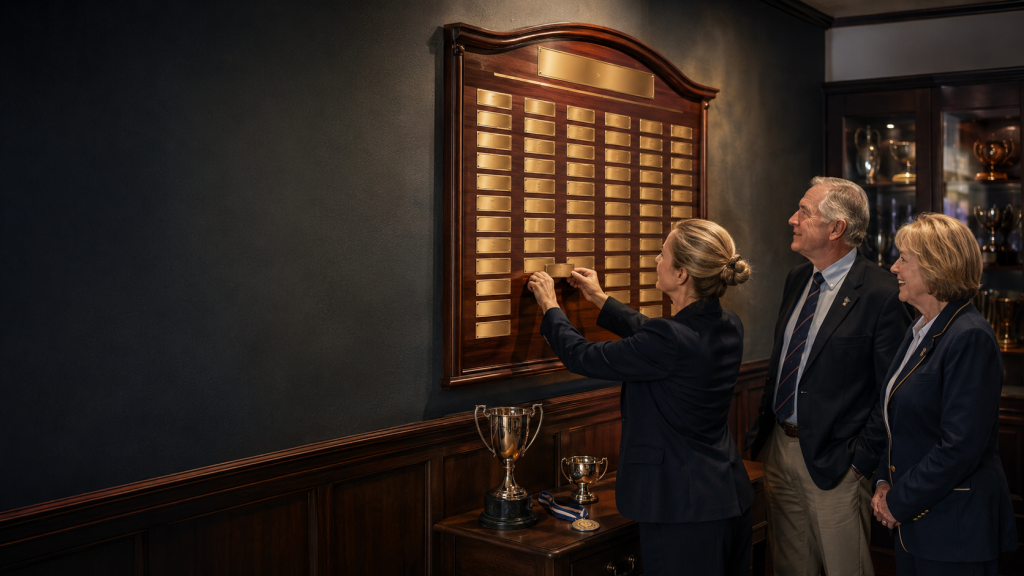
How to Create a Roll of Honours for Your Club or Organisation
21/08/2026A roll of honours is a permanent record of the people who have achieved, contributed or served within a club, school or organisation. It might list premiership teams, club presidents, captains, life members, academic leaders, award recipients or other important names from the organisation’s history.
Creating one involves more than placing names on a board. You need to decide what will be recognised, verify historical records, choose a format with enough room for future additions and establish a consistent system for updating it.
For many Australian organisations, a physical honour board, series of engraved plaques or perpetual trophy provides the most visible and lasting solution. This guide explains how to plan a roll of honours that is accurate, readable and practical to maintain.
What Is a Roll of Honours?
A roll of honours is an organised record of recipients, office bearers, teams or achievements over multiple years. It may be displayed on a traditional timber honour board, engraved metal or acrylic panel, wall plaque, perpetual shield or another permanent presentation piece.
The terms “roll of honours”, “honour board” and “honours board” are often used to describe similar displays. The most appropriate wording usually depends on the organisation’s existing traditions.
Common examples include:
- Club presidents and committee leaders
- Life members
- Premiership teams
- Club champions
- Best and fairest winners
- School captains and student leaders
- Academic or sporting award recipients
- Coaches and captains
- Volunteer service awards
- Competition winners
- Sponsors or founding members
Unlike a one-off trophy, a roll of honours grows over time. Its design must therefore work for both the names already being recorded and those that will be added in future years.
Step 1: Decide What the Roll Will Recognise
Begin by defining the purpose of the display. A broad board titled “Club Honour Roll” may seem flexible, but it can become difficult to organise if it combines unrelated achievements.
In many cases, separate boards or sections create a clearer historical record. For example, a sporting club might use individual sections for:
- Presidents
- Life members
- Premierships
- Club champions
- Best and fairest winners
- Coaches and captains
A school might instead create separate records for student leaders, sporting achievements, academic awards and community service.
Ask these questions before choosing the board:
- Who or what will be listed?
- What qualifies a person for inclusion?
- Will names be added annually or only occasionally?
- Does the organisation already have an established award title?
- Who will approve future additions?
- How many years should the display accommodate?
Writing down the inclusion criteria helps future committees maintain the same standard.
Step 2: Collect and Verify the Historical Information
The most time-consuming part of creating a roll of honours is often confirming the records.
Gather information from reliable sources available to your organisation, such as:
- Annual reports
- Meeting minutes
- Presentation-night programs
- School yearbooks
- Club newsletters
- Existing trophies and plaques
- Competition records
- Photographs with captions
- Past committee members
- Archived membership records
Enter the information into a spreadsheet using a consistent set of columns. Depending on the display, these might include year, recipient, position, team, division and award category.
Mark uncertain entries rather than guessing. If two records conflict, investigate the discrepancy before submitting the final list for engraving. For older organisations, it may be sensible to identify unconfirmed years as gaps rather than insert information that cannot be verified.
Have at least two people review the completed list. Ideally, one should be familiar with the organisation’s history and another should check spelling, dates and formatting independently.
Step 3: Standardise Names, Dates and Titles
A roll of honours looks more professional when every entry follows the same format. Decide on a style before preparing the artwork or engraving instructions.
Names
Choose whether to use:
- Full first and last names
- Initials and surnames
- Preferred names
- Titles or post-nominals
Avoid changing styles from year to year unless there is a clear reason. If early records only contain initials, decide whether to retain that historical format or expand names where the information can be verified.
Years
Use one consistent format, such as:
- 2025
- 2025–26
- Season 2025
- 2025 Premiership
For competitions spanning two calendar years, confirm how the organisation officially identifies each season.
Positions and Awards
Use the formal title recognised by the organisation. For example, avoid alternating between “Club President”, “President” and “Chairperson” if these entries refer to the same position.
If the title has officially changed over time, recording the historically correct title may be more appropriate.
Step 4: Choose the Right Display Format
The best format depends on the number of records, available wall space, presentation setting and frequency of updates.
Traditional Honour Board
A traditional honour board provides a prominent wall display for clubrooms, schools, association offices and community facilities. Names may be applied directly to the board or added using individual plates.
This format works particularly well for:
- Long lists of annual office bearers
- Life members
- School captains
- Premiership records
- Club champions
- Historical recognition displays
Before choosing a board, consider how many existing entries it must hold and how many years of future additions should be allowed.
Engraved Plaques
Individual plaques or panels offer a flexible approach. They can be arranged as a coordinated wall display and added to as new recipients are selected.
Plaques can be helpful when:
- The available wall space has an unusual shape
- Different categories need separate sections
- The organisation expects the display to expand
- Individual records require more information
- A modular layout is preferred
NMTG provides a range of engraving services, including trophy plates, stainless steel plaques, custom-cut metal plaques, laser engraving on timber and full-colour sublimation printing for plaques.
Perpetual Trophy or Shield
A perpetual trophy is suitable when one award is presented each year and the organisation wants a portable ceremonial item.
The main trophy or shield can display each recipient on an individual plate. It may remain at the club or school after the presentation, while the current winner receives a smaller trophy, medal or certificate to keep.
Perpetual trophies work well for awards such as:
- Club Person of the Year
- Best and Fairest
- School Dux
- Volunteer of the Year
- Annual competition champion
- Memorial awards
The amount of available plate space should be checked carefully. A design that accommodates only a few years may require replacement or modification sooner than expected.
Combined Display
Some organisations use a large honour board for the permanent historical record and a perpetual trophy during the annual presentation ceremony. This combines a visible wall display with the tradition of presenting a physical award.
Step 5: Plan for Future Names
Future capacity is one of the most important design considerations.
Estimate how often new names will be added and how long the board should remain usable. An annual award needs more space than an honour granted only occasionally.
Consider:
- The number of existing entries
- How many names are added each year
- Whether additional categories may be introduced
- Whether the board can accept extra plates or panels
- How future entries will be aligned
- Whether the display can be extended without looking mismatched
Leaving excessive blank space can make a new display feel unfinished, but leaving too little may result in an overcrowded board. A balanced design should look complete now while allowing orderly expansion.
Step 6: Choose a Clear, Lasting Design
An honour board should be attractive, but readability is more important than decoration.
Prioritise Legibility
Use lettering that can be read comfortably from the normal viewing distance. Highly decorative fonts may suit a heading but can make long lists of names difficult to scan.
Create a Clear Hierarchy
The board should distinguish between:
- The organisation’s name
- The title of the roll
- Section headings
- Years
- Recipients’ names
- Positions or achievements
Consistent spacing and alignment help viewers follow the information.
Use Organisational Branding Carefully
A club or school logo, established colours or a short founding date can personalise the design. However, branding should not compete with the historical record.
The suitability of a logo will depend on the engraving or printing method and the quality of the supplied artwork. NMTG’s frequently asked questions explain its preferred file formats and how customers can provide logos and engraving details.
Consider the Display Environment
Think about where the finished piece will hang. Note the wall size, lighting, viewing distance and surrounding colours. If the location is exposed to unusual conditions, discuss this when selecting the material and production method.
Step 7: Prepare the Engraving Information
Supply the final information in a structured document or spreadsheet rather than within a long email.
A useful layout might include:
| Year | Recipient | Position or Award | Notes |
|---|---|---|---|
| 2024 | Jordan Taylor | Club Champion | Confirmed |
| 2025 | Casey Morgan | Club Champion | Confirmed |
| 2026 | Alex Nguyen | Club Champion | Confirmed |
Use the notes column for internal checking only unless the information needs to appear on the display.
Before approving the final layout:
- Check every name against the source records
- Confirm the order of years
- Review capitalisation and punctuation
- Confirm official award titles
- Check the organisation’s name and logo
- Make sure blank years are handled consistently
- Confirm the number of future spaces
Spelling deserves particular attention because the roll is intended to become a long-term record.
Step 8: Establish an Annual Update Process
A roll of honours is most useful when it stays current. Responsibility for updates should not disappear when committee members or school staff change.
Add the following task to the organisation’s annual presentation or administration checklist:
- Confirm the new recipient or office bearer.
- Check the spelling of their name directly with them.
- Record the year and formal award title.
- Obtain committee or school approval.
- Arrange engraving or production.
- Update the master spreadsheet.
- Save supporting records in the organisation’s archive.
Keeping a master file prevents future committees from having to reconstruct the entire history.
Common Mistakes to Avoid
Starting Without Confirmed Records
Do not finalise the layout until the historical list has been checked. Late additions can affect spacing and alignment.
Choosing a Board with Insufficient Capacity
Plan beyond the current year. An annual award can fill a small display quickly.
Mixing Formatting Styles
Variations in dates, initials and award titles can make the board look disorganised. Create a style guide, even if it is only a short document.
Using Lettering That Is Too Small
Trying to fit every name onto one board can make the information difficult to read. Additional panels may provide a better result.
Failing to Assign Responsibility
Without an annual process, several years may pass before anyone notices the board is out of date.
Submitting Unchecked Engraving Details
The person compiling the list should not be its only proofreader. Ask another committee member, teacher or administrator to review it independently.
Frequently Asked Questions
What is the difference between a roll of honours and an honour board?
A roll of honours is the record itself, while an honour board is one way of displaying that record. A roll can also appear on plaques, engraved panels, a perpetual shield or a combination of formats.
How much future space should we allow?
Estimate how many entries are added each year and how long you want the current display to remain in use. An annual award requires considerably more future capacity than a life membership granted occasionally.
Can an existing honours board be updated?
In many cases, new names or plates can be added to an existing board. The possibilities depend on its material, condition, lettering style and remaining space. Photographs and measurements can help an engraving provider assess the options.
What should we do if some historical names are missing?
Do not guess. Record the missing years in your working file and continue researching club archives, school records or past members. The display can acknowledge a gap without presenting unverified information as fact.
Is a perpetual trophy enough on its own?
It may be suitable for a single annual award, particularly if it has enough room for future names. A separate honour board may be more practical when several categories or a long historical record need to be displayed.
Create a Roll of Honours That Can Grow with Your Organisation
A successful roll of honours begins with accurate records and a clear purpose. Once those foundations are in place, you can choose an honour board, set of plaques, perpetual trophy or combined display that suits the organisation’s space, traditions and plans for future recognition.
New Millenium Trophies & Embroidery works with sporting clubs, schools, businesses and organisations in Wollongong, across the Illawarra and throughout Australia. Its in-house capabilities include laser and computer engraving, glass sandblasting, sublimation, trophy plate engraving and custom signage.
Explore NMTG’s perpetual trophies, view examples in the engraving gallery or contact the NMTG team to discuss a new or existing recognition display.